Expert guidance for complex cell biology workflows.
We help biopharma, biotech, startups, academic groups, and emerging AI-driven biology teams design stronger in vitro models, smarter fluorescence workflows, and clearer imaging strategies.
2D, 3D, organoids, spheroids, biomaterials, microengineered systems
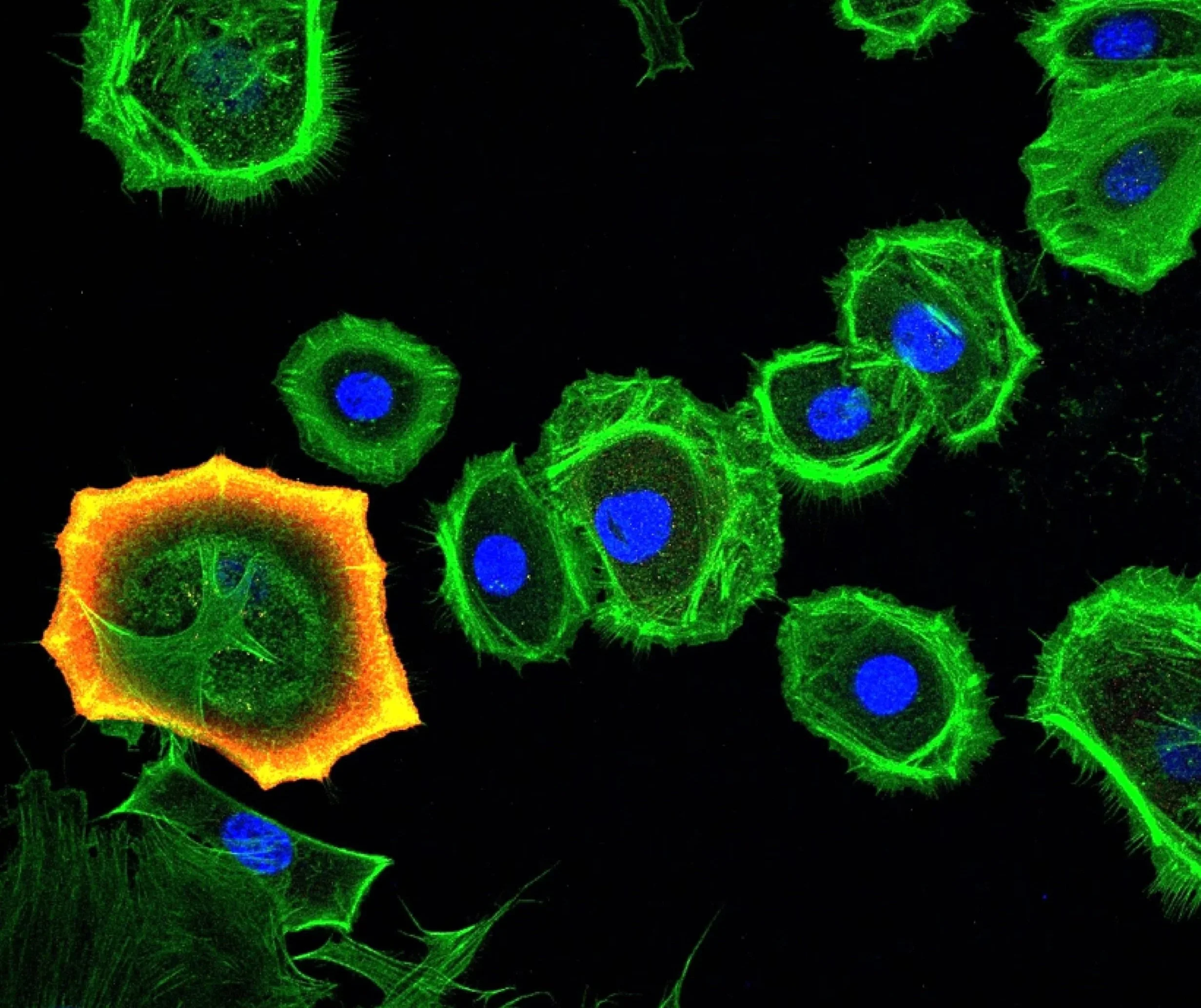
Markers, antibodies, multiplex staining, tracking, spatial readouts
Acquisition planning, modality selection, complex 2D and 3D samples
Quantitative pipelines, biological interpretation, imaging-based validation
Rather than offering generic advice, we work at the intersection of biology, biomaterials, imaging, and engineering to help shape experiments that are more physiologically relevant, technically robust, and decision-ready.
What we consult on
Open each area to quickly see what is included.
01
Fluorescence Labeling & Tracking Strategy
Design better staining workflows, marker panels, and spatial readouts.
Fluorescence Labeling & Tracking Strategy
Design better staining workflows, marker panels, and spatial readouts.
Includes
- ICC/IF assay planning
- Marker and antibody selection
- Multiplex staining strategy
- Fluorescent labeling design
- Spatial protein analysis planning
Best for
Teams building new fluorescence assays or improving readout quality, specificity, multiplexing, and biological relevance.
02
Advanced in vitro Models, Biomaterials & Microengineering
Build more relevant cellular systems and engineered platforms around your biology.
Advanced in vitro Models, Biomaterials & Microengineering
Build more relevant cellular systems and engineered platforms around your biology.
Includes
- Advanced 2D and 3D culture strategy
- Spheroid and organoid planning
- Tissue-specific model design
- Biochemical and biomechanical cue selection
- Biomaterial and hydrogel selection
- Matrix mechanics and ligand presentation strategy
- Tissue-mimetic microenvironment design
- Microengineered and assay-compatible platform strategy
- Microfluidic and lab-on-a-chip direction
- 3D bioprinting design considerations
Best for
Teams seeking more predictive and structured models than standard cell culture, including programs working with biomaterials, engineered microenvironments, organoid systems, or scalable translational platforms.
03
Imaging Strategy, Quantitative Analysis & Validation
Choose the right imaging path and turn complex datasets into usable biological insight.
Imaging Strategy, Quantitative Analysis & Validation
Choose the right imaging path and turn complex datasets into usable biological insight.
Includes
- Microscopy modality selection
- Acquisition planning for 2D and 3D samples
- Quantification pipeline design
- Biological interpretation of spatial data
- Imaging-based experimental validation strategy
Best for
Teams that need clearer imaging decisions, cleaner datasets, stronger biological interpretation, or wet-lab validation support around cellular imaging workflows.
Built for teams solving complex biological questions.
Need guidance on model design, imaging strategy, or assay development?
Tell us about your project and we’ll help define the most relevant scientific and technical path forward.