AI Is Entering the Wet Lab. What Biology Should We Put in the Loop?
Closed-loop labs can search experimental space faster than ever. What they learn still depends on the biology inside the experiment.
AI is moving from analyzing experiments to helping decide what should be tested next. Robotic systems can run protocols, collect measurements, update a model, and use what they learned to guide another round.
That can make experimental search faster and more consistent. It does not automatically make the evidence more useful.
You can automate a biologically weak model perfectly and still generate weak evidence at scale.
Once discovery becomes a loop, the biological model becomes part of the learning architecture. It determines which biological relationships can actually be interrogated. The cells, their environment, the way they are perturbed, what we measure, and when we measure it all shape the evidence that enters the loop.
Automation and traceability help the loop run reliably. The biology still determines what the system has a chance to learn.
Build a controlled experimental representation containing the biological features required for the question.
Autonomous search is becoming experimentally real
Closed-loop experimentation connects each round of laboratory work to the next. Researchers define the question and the space they want to explore. Robotics runs selected conditions, instruments measure the result, and a computational model uses those results to help choose what should be tested next. The advantage is that each round can build on the one before it.
Kanda and colleagues demonstrated this in the optimization of iPSC-to-retinal-pigment-epithelium differentiation. Their robotic system used batch Bayesian optimization to navigate an estimated 200 million possible parameter combinations. It tested 143 conditions over 111 days and improved the pigmentation score of retinal pigment epithelial cultures by 88% relative to the pre-optimized protocol [1].
In protein engineering, Rapp and colleagues deployed four independent agents using the Self-driving Autonomous Machines for Protein Landscape Exploration (SAMPLE) platform. The agents explored less than 2% of a defined sequence landscape and identified enzymes with T50 values at least 12 °C higher than their starting sequences [2].
These studies show how powerful automated search can be when the objective is clear and the experimental system is controllable. Drug discovery adds another requirement. The readout being optimized has to reflect biology that matters for the therapeutic question.
Kanda et al., eLife (2022). The optimized score was followed by separate biological characterization. The optimization target alone was not treated as sufficient validation.
Search efficiency is not the same as biological validity.
Reproducibility, throughput, and biological relevance are different properties
Reproducibility asks whether the same process produces comparable results across wells, batches, operators, and time. Throughput asks how many conditions can be executed and measured. Biological relevance asks whether the system contains the features needed to support a particular inference about human disease.
Human origin and disease relevance are not the same thing. A model can be built from human cells and still omit a feature that matters for a particular disease question. Disease relevance depends on what the experiment needs to represent. That may include cell identity and state, interactions between cell populations, extracellular signals, mechanical context, spatial organization, treatment history, timescale, or functional phenotype. Not every model needs every feature.
Automation is especially useful for reproducibility and scale. It can control timing and handling, reduce operator-dependent variation, preserve experimental records, and expand the number of conditions that can be tested. Biological relevance comes from a different set of choices, including which cells are used, what surrounds them, how they are organized, how treatment is delivered, what is measured, and what decision the experiment is meant to support.
The retinal differentiation study makes the distinction concrete. Pigmentation was the optimization target, but the investigators did not equate a higher score with a fully validated cell state. They separately evaluated characteristic RPE markers, secreted factors, and tight-junction-associated ZO-1 [1]. The algorithm optimized what it was given. Additional biological characterization established whether the resulting cells retained key RPE characteristics.
In a closed loop, those choices carry forward. If an important part of the biology is missing, the learning signal can be incomplete, and that signal can shape which experiments are selected next.
Disease relevance is only part of the challenge. Drug discovery ultimately asks intervention questions: what changes when a target, pathway, or biological mechanism is perturbed? Observational measurements can reveal states and associations. Controlled perturbation allows mechanistic hypotheses to be tested experimentally, although perturbation alone does not establish causality.
More complexity is not automatically more informative. There is no universally relevant biological model. Relevance depends on the question being asked, and a useful model is one that preserves the biology required for the inference it is intended to support.
Complex human biology is becoming experimentally scalable
Brandenberg and colleagues created microcavity arrays for scalable suspension culture and real-time analysis of thousands of gastrointestinal organoids. In the tested mouse and human systems, the absence of a solid extracellular matrix reduced organoid heterogeneity and enabled automated high-content phenotypic screening of patient-derived colorectal cancer organoids [3].
Neural systems are also becoming tractable at meaningful scale. Narazaki and colleagues screened biocompatible polymers to prevent fusion during suspension culture of human cortical organoids. The selected polysaccharide increased yield while preserving regional patterning, neuronal morphology, and functional activity. The group then screened 298 FDA-approved drugs and teratogens using more than 2,400 cortical organoids [4].
Scale is valuable, but predictive relevance must still be demonstrated for the intended context. Vlachogiannis and colleagues built a living biobank from 110 biopsies from 71 patients with metastatic colorectal or gastroesophageal cancers. In 21 paired organoid–clinical response comparisons, they reported 100% sensitivity, 93% specificity, 88% positive predictive value, and 100% negative predictive value for targeted agents or chemotherapy [5].
The paired cohort was small, heavily pretreated, and limited to specific metastatic gastrointestinal cancers and therapies. The study does not validate all organoids or establish universal clinical predictivity. It shows why human provenance and clinically anchored validation can change the value of an experimental system.
A human model can be more representative for a particular biological question without being clinically predictive. Those are different claims, and predictive performance has to be shown separately.
The goal is not complexity for its own sake. It is the right biological context, built in a controlled way.
Every layer constrains the next experiment
A closed-loop discovery system depends on every part of the experiment working together. Disease-relevant human biology defines what can be interrogated. Controlled perturbation tests how the system responds when a defined biological or therapeutic variable is changed, enabling mechanistic hypotheses to be examined experimentally. Multimodal measurement captures the response across the modalities, spatial scales, and timescales that matter for the question. Computation can then integrate the resulting evidence, compare competing explanations, quantify uncertainty where appropriate, and help choose what should be tested next. Automation, quality control, and traceability support the entire process.
The purpose of the loop is not simply to accumulate data. Each experiment should change what we know. It may strengthen or challenge a hypothesis, identify what should be tested next, reveal what can be deprioritized, show where additional measurements are needed, or expose a place where the biological model itself needs refinement.
The next experiment should help reduce uncertainty or distinguish between plausible explanations, not simply improve a convenient score. Scientific judgment remains important when choosing the model, setting its boundaries, validating the readouts, and interpreting what the results mean.
Closed-loop systems span different degrees of autonomy. The 2026 Robin study, for example, described a semi-autonomous workflow that retained human execution of laboratory experiments [6]. Autonomous discovery therefore describes a trajectory toward increasingly integrated experimental and computational decision-making, rather than a binary state.
This emphasis on context also appears in the evolving framework for New Approach Methodologies. FDA’s 2025 roadmap includes advanced in vitro systems and computational approaches in its strategy to reduce animal testing, while its March 2026 draft guidance identifies context of use, human biological relevance, technical characterization, and fitness for purpose as key features of NAM validation [7] [8]. The guidance does not address the use of NAMs in drug discovery, but the underlying principle is relevant here. An experimental method must be evaluated in relation to the question it is intended to answer.
Starting where biological context matters
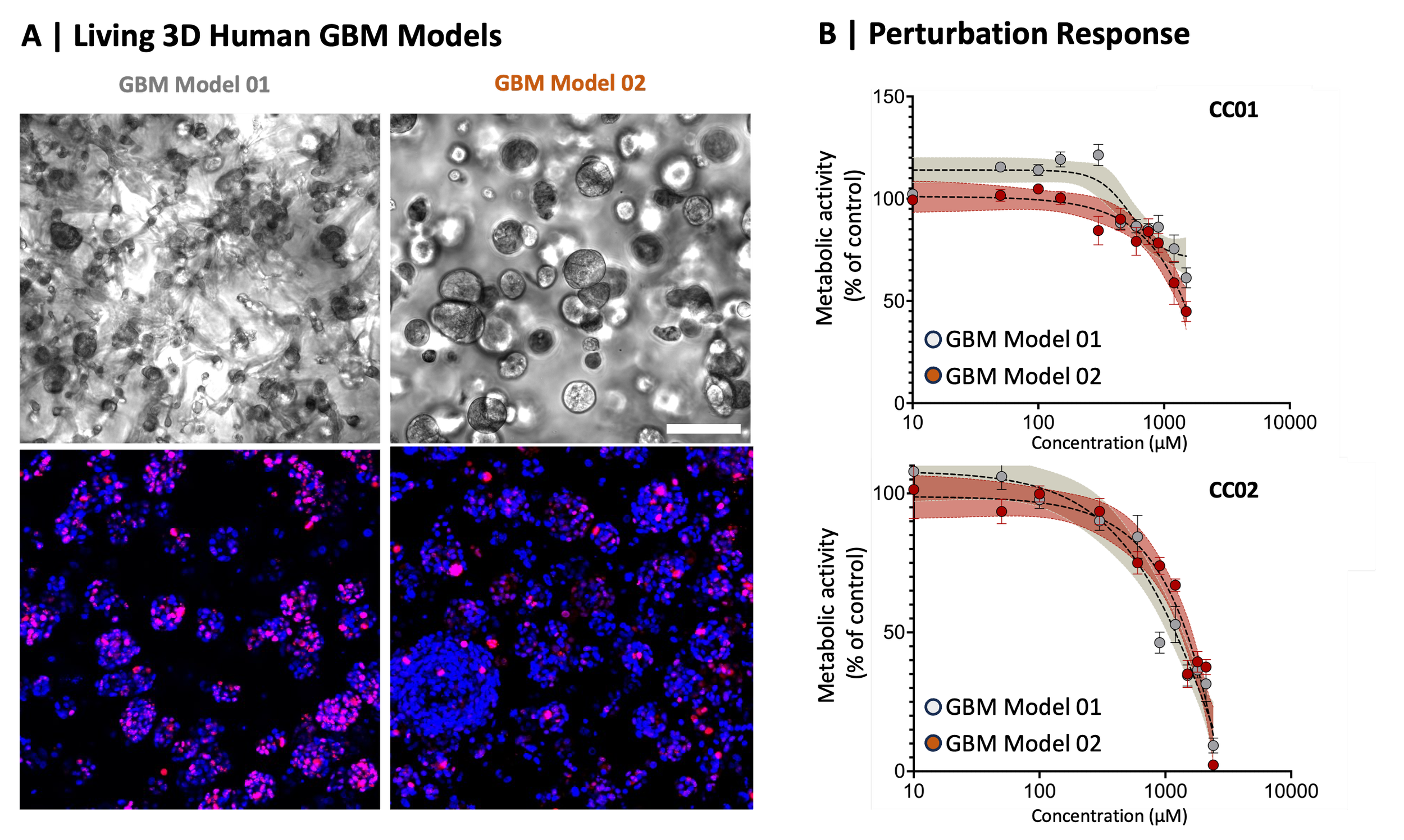
CellCircuit is beginning in neuro-oncology, with an initial focus on brain tumors, including glioblastoma (GBM). GBM is a strong starting point because its behavior depends on much more than the tumor cells alone. The surrounding brain, the extracellular environment, cell state, spatial organization, and changes over time can all influence how the disease behaves and how it responds to treatment.
GBM cells can move between different biological states [9]. They can also interact directly with neural circuits [10]. For questions in which these interactions influence mechanism or therapeutic response, a useful GBM model has to represent more than tumor cells growing in three dimensions.
Research carried out at Stanford and led by CellCircuit CEO Sadegh Ghorbani as first author provides one example. The finding illustrates a broader principle. Even when two 3D environments had similar stiffness, changing how the surrounding material relaxed over time changed how GBM cells organized and behaved [11].
The implication is practical. “3D” alone does not establish biological relevance. The environment surrounding the cells can alter the phenotype being measured, which makes control of that environment important for interpretation and reproducibility.
We are not trying to recreate an entire tumor in a dish. A native tumor is a complex and evolving biological system, and no in vitro model should be assumed to reproduce its full context. Nor is complete recapitulation necessary for every experimental question. The objective is to reconstruct, control, and measure the biological features required for the question being asked, while understanding what the model includes, what it omits, and therefore what conclusions it can support.
The same architecture can extend across neuro-oncology and, over time, into additional CNS and PNS disease areas. We are beginning with a focused biological and therapeutic context while building a platform designed for broader disease biology.
CellCircuit brings together disease-relevant living human models, controlled perturbation, longitudinal and multimodal measurement, traceable data, and computational learning. We describe this framework as Human Biology Intelligence.
The objective is not simply to generate more data. It is to generate evidence that changes the next decision.
The opportunity is not simply to automate experiments. It is to build a discovery system that learns through human biology.
AI is entering the wet lab. The consequential question is which biology we choose to place inside the loop.
References
-
Kanda GN, Tsuzuki T, Terada M, et al. Robotic search for optimal cell culture in regenerative medicine. eLife. 2022;11:e77007. 10.7554/eLife.77007 ↗
-
Rapp JT, Bremer BJ, Romero PA. Self-driving laboratories to autonomously navigate the protein fitness landscape. Nature Chemical Engineering. 2024;1:97–107. 10.1038/s44286-023-00002-4 ↗
-
Brandenberg N, Hoehnel S, Kuttler F, et al. High-throughput automated organoid culture via stem-cell aggregation in microcavity arrays. Nature Biomedical Engineering. 2020;4:863–874. 10.1038/s41551-020-0565-2 ↗
-
Narazaki G, Miura Y, Pavlov SD, et al. Scalable production of human cortical organoids using a biocompatible polymer. Nature Biomedical Engineering. 2025;9:2115–2123. 10.1038/s41551-025-01427-3 ↗
-
Vlachogiannis G, Hedayat S, Vatsiou A, et al. Patient-derived organoids model treatment response of metastatic gastrointestinal cancers. Science. 2018;359:920–926. 10.1126/science.aao2774 ↗
-
Ghareeb AE, Chang B, Mitchener L, et al. A multi-agent system for automating scientific discovery. Nature. 2026;655:497–505. 10.1038/s41586-026-10652-y ↗
-
U.S. Food and Drug Administration. Roadmap to Reducing Animal Testing in Preclinical Safety Studies. 2025. FDA roadmap ↗
-
U.S. Food and Drug Administration. General Considerations for the Use of New Approach Methodologies in Drug Development. Draft Guidance for Industry. March 2026. FDA draft guidance ↗
-
Neftel C, Laffy J, Filbin MG, et al. An integrative model of cellular states, plasticity, and genetics for glioblastoma. Cell. 2019;178:835–849.e21. 10.1016/j.cell.2019.06.024 ↗
-
Venkataramani V, Tanev DI, Strahle C, et al. Glutamatergic synaptic input to glioma cells drives brain tumour progression. Nature. 2019;573:532–538. 10.1038/s41586-019-1564-x ↗
-
Ghorbani S, Huang MS, Zhang D, et al. Matrix stress relaxation drives glioblastoma cell response in viscoelastic biomaterials. Science Advances. 2026;12(34):eaef7087. 10.1126/sciadv.aef7087 ↗